Choose a Meta instant form when the offer is easy to understand and your team can qualify the enquiry after submission. Choose a landing page when the buyer needs more explanation, proof or a booking journey before contacting you. Test the two against the same business outcome when both are credible options.
Neither destination guarantees better leads. A short form can attract suitable buyers; a detailed page can still attract the wrong people. The useful question is which route helps your particular customers understand the offer and take a meaningful next step.
This guide helps service businesses compare the choices, define lead quality and build a test they can evaluate. It applies to businesses serving local or international customers, without assuming that a result from one country or industry will transfer to another.
What changes between an instant form and a landing page?
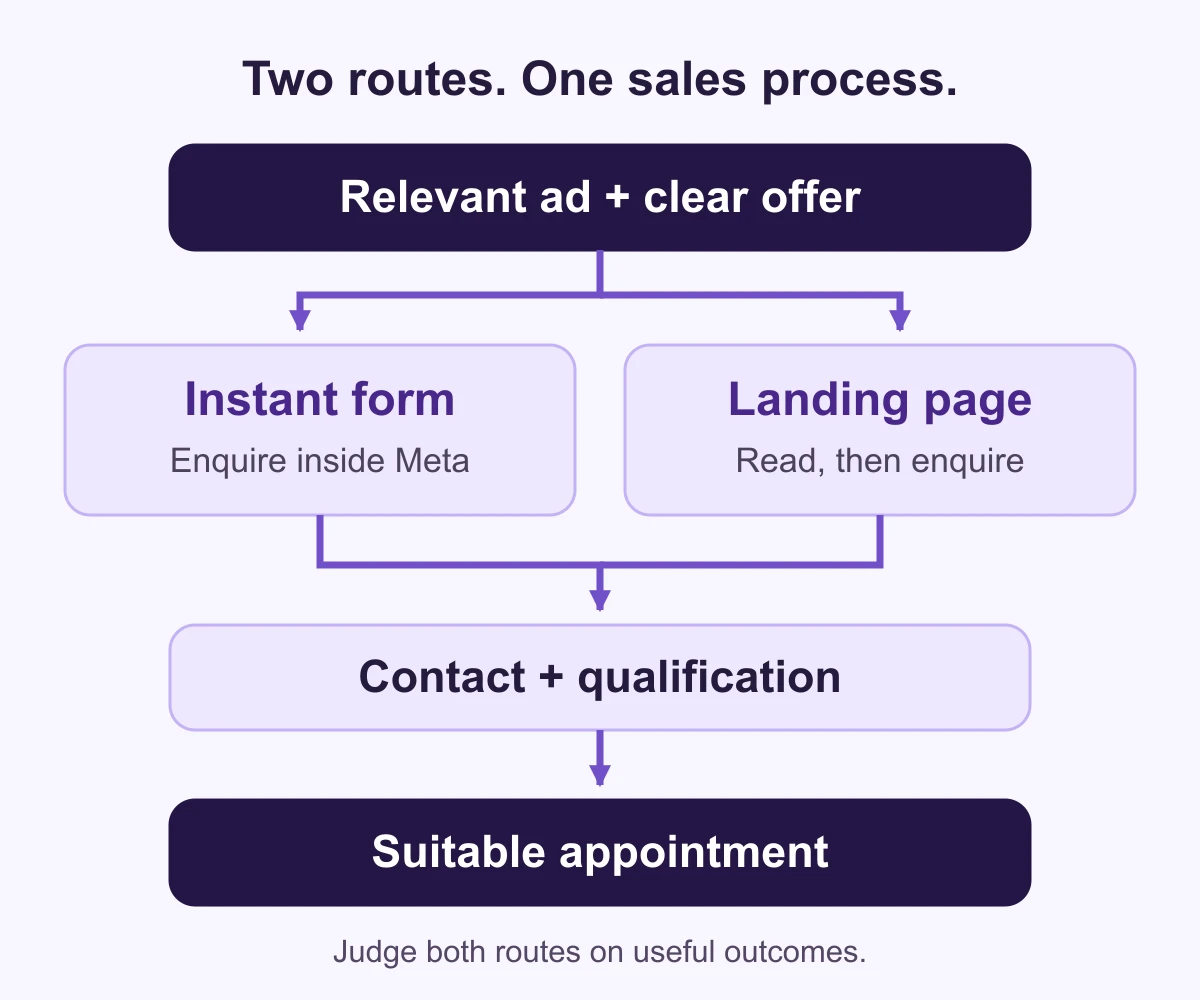
An instant form collects an enquiry within Meta’s environment. A landing page is a page on your website where the visitor can review the offer and submit a form or take another relevant action. Meta’s lead-generation guide describes these two routes.
Think about where the explanation and qualification happen. With an instant form, more of the conversation may happen after submission. With a landing page, you can put more information before the contact step. Either route still needs a clear offer, dependable delivery and someone responsible for the response.
The choice here concerns the destination of a Meta campaign. If you are still choosing an advertising channel, start with our Google Ads versus Meta Ads comparison. A destination test cannot resolve a fundamentally unsuitable offer or channel.
A decision table for your first choice
Use this table to select a starting hypothesis. It is a planning aid, not a ranking of which format performs best. If both columns seem plausible, decide whether your budget and team can support a meaningful comparison.
| Your situation | Instant form may fit | Landing page may fit |
|---|---|---|
| Offer | One clearly described service or introductory step | A service needing explanation of scope, process or options |
| Proof | The ad and a concise introduction establish enough context | Buyers need examples, detailed answers or evidence before enquiring |
| Next step | A team member qualifies the request afterwards | A booking, quote tool or structured website journey matters |
| Questions | A few relevant answers let the team begin a conversation | The visitor needs guidance while choosing or supplying details |
| Website readiness | The relevant website journey is not yet ready | The mobile page, form and delivery have been tested |
| Operations | Someone can reliably contact and qualify new enquiries | The website supports useful self-selection before the team responds |
| Measurement | The team can connect submitted leads with later outcomes | The team can connect website submissions with later outcomes |
Website readiness is not a reason to postpone every campaign, but it is a reason to avoid sending paid visits into a broken journey. Our website improvement guide can help scope the necessary repairs.
Define a qualified lead before comparing costs
Agree a simple definition with the people who handle enquiries. For example: the person needs a service you provide, is in a market you can serve, and has supplied enough information for a relevant next conversation. Adapt the criteria to the business rather than copying an agency’s generic score.
Separate an unanswered call from a clearly unsuitable request. Someone you have not reached is still unassessed; treating every missed call as a bad lead can hide a response problem. Record the reason for rejection, such as a different service, an unsupported location or no genuine request.
Keep distinct stages for submitted, contacted, qualified, booked and won. Give each lead a source label so the team can trace its route without relying on memory. Review a small sample together before the test starts to make sure everyone applies the same definitions.
For international enquiries, include working languages, time zones and service coverage in that assessment. A promising request is not operationally suitable if nobody can deliver the service or handle the conversation. State these practical limits in the offer where they help buyers decide.
When an instant form is a sensible starting point
Consider this route when the initial promise is specific: request a workshop outline, discuss a defined service, or arrange an introductory conversation. The ad should explain what is being requested and what happens after submission. A vague promise attracts people with different expectations.
Ask only questions that change your next action. A training provider might ask whether the request concerns an individual place or a team workshop. A maintenance company might ask which service is needed. Explain why a question matters if the answer takes effort; avoid collecting detail your team never uses.
Review the form options actually available in your account. Test the experience from the customer’s perspective, including the confirmation and next-step message. Do not assume that a saved contact detail is current or that a completed form means an appointment has been agreed.
Plan the handover before launch. Who receives the lead, where is it recorded, and what happens if the normal owner is absent? An automated acknowledgement can set expectations, but someone still needs responsibility for the conversation and its outcome.
When a landing page earns the extra step
A landing page is useful when the customer needs context before enquiring. A consultancy may need to explain which projects it accepts; a specialist installer may need to show the process, service area and examples. A relevant page lets people assess these details without turning the first phone call into a full introduction.
Build around one offer. Carry the ad’s promise into the headline, explain who the service suits, show real evidence and make the next step clear. Avoid mixing several unrelated services simply because they share the same website.
Our landing-page guide develops the connection between message, proof and enquiry. For a new test, use the parts relevant to your offer rather than copying another market’s wording or claims.
Test on an actual phone: read the page, open the form, enter details, correct an error and verify delivery. Use clear field labels and instructions; W3C’s guidance on form labels explains their accessibility purpose. A beautiful page does not compensate for an unusable contact step.
Compare useful outcomes with a worked example
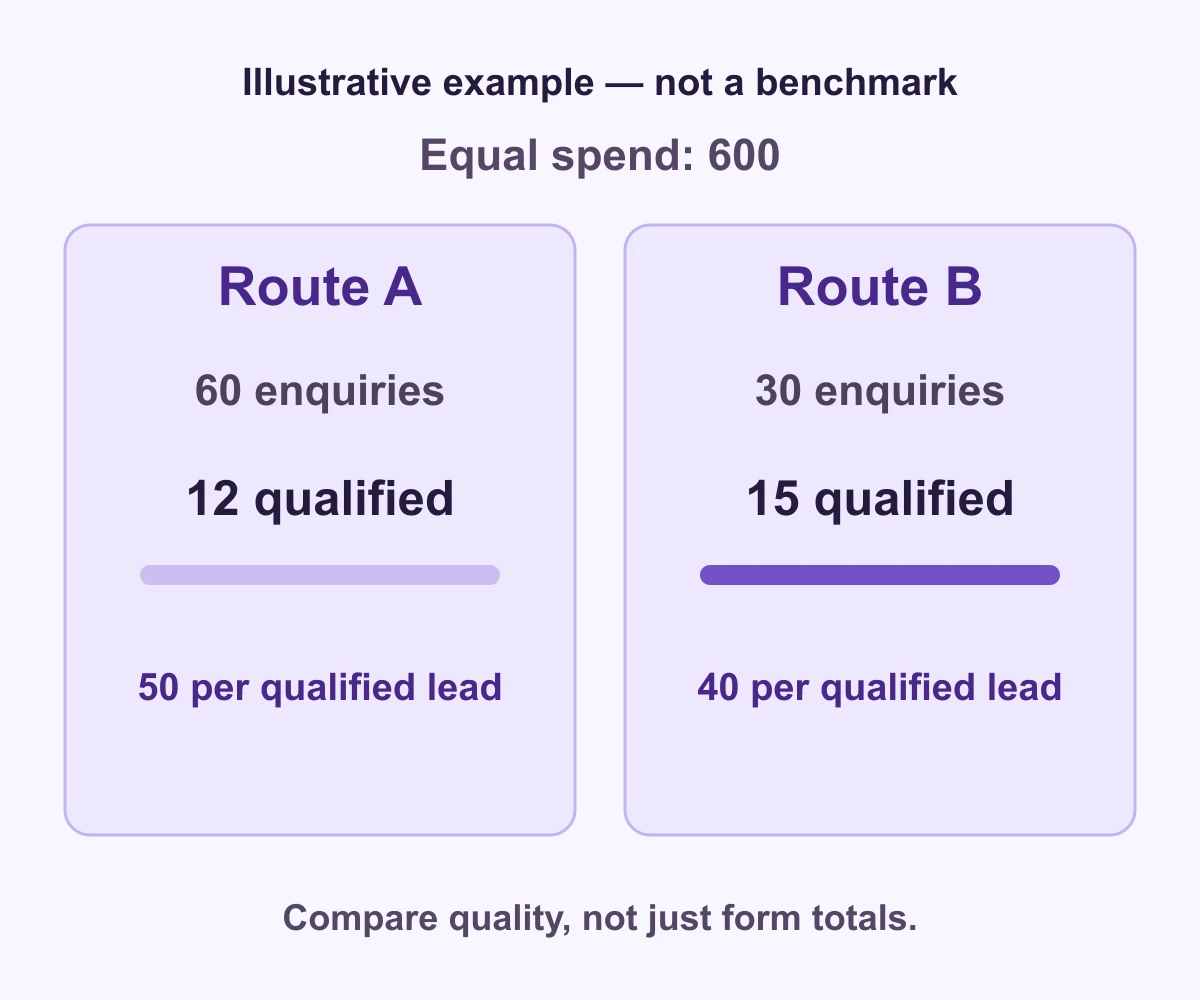
The figures below are entirely hypothetical, use the same unspecified currency unit and are not performance benchmarks. Route A could be either destination. Assigning it to an instant form in advance would prejudge the test.
| Measure | Route A | Route B |
|---|---|---|
| Advertising spend | 600 | 600 |
| Enquiries | 60 | 30 |
| Qualified opportunities | 12 | 15 |
| Cost per enquiry | 10 | 20 |
| Cost per qualified opportunity | 50 | 40 |
| Qualification rate | 20% | 50% |
Route A wins on the cost of a submitted form; Route B wins on cost per qualified opportunity. You still need appointment, sales and delivery information to decide which creates more business value. If one route takes much more staff time, include that effort in the assessment.
Design a test you can interpret
Write a brief before building the campaigns. State the offer, audience, market, qualifying definition, review window and extra amount you can afford to test. Use comparable creative and the same service promise so a completely different message does not explain the result.
Where available and suitable, use a controlled experiment that separates the audiences. Two campaigns running side by side are not automatically a clean experiment: delivery, audience overlap and timing can affect the comparison. Record limitations and treat a directional pilot as a pilot.
Check both routes technically before paid delivery begins. A missing lead notification or a duplicate event can invalidate the comparison. Keep a change log and avoid repeatedly replacing the offer, page, audience and questions during the same evaluation window.
Allow for the normal time between an enquiry and a meaningful outcome. If few leads have reached the qualifying stage, report that uncertainty instead of declaring a winner from early totals. There is no universal budget, number of days or lead count that makes every service-business test conclusive.
Make follow-up part of the comparison
Set a response process the team can actually maintain. Tell customers when and how they will hear from you. Assign an owner, define how missed calls are handled, and record the next step rather than letting enquiries disappear into individual inboxes.
Capture consistent outcome labels in your CRM or another controlled record. If you use platform integrations or feedback signals, verify eligibility, configuration and permitted data handling before relying on them. Avoid sending sensitive information as part of ordinary marketing events.
Review rejection reasons by destination. A pattern of wrong-service requests may point to the ad’s wording. Suitable people who do not book may need clearer pricing expectations or a better appointment process. A backlog of unanswered leads calls for an operational change, whichever form produced them.
Questions business owners often ask
Are landing-page leads always better?
No. A page gives you room to explain and qualify, but the offer, audience, form and follow-up still determine what happens. A strong instant-form route can suit the same business. Use your own downstream evidence.
Should a small business run both immediately?
Only if it can afford and manage a useful comparison. Splitting a limited budget across too many tests can leave every result unclear. Start with the more credible route, repair obvious failures and compare a second route when there is a practical reason.
What should the agency report?
Ask for spend, enquiries, contacted leads, qualified opportunities and appointments, with definitions and unresolved cases explained. Discuss sales outcomes when reliable data exists. Keep the report tied to the business decision.
Choose the next practical step
Choose the route that fits the explanation your customer needs and the follow-up your team can provide. Improve the offer and enquiry journey before treating a larger budget as the solution; our budget readiness checklist is a useful final check.
GoSocial can assess the ad, destination and lead handover together. Explore our Meta Ads management, or our services for UK businesses and US businesses. Discuss your lead-generation project with us to define a useful first test.