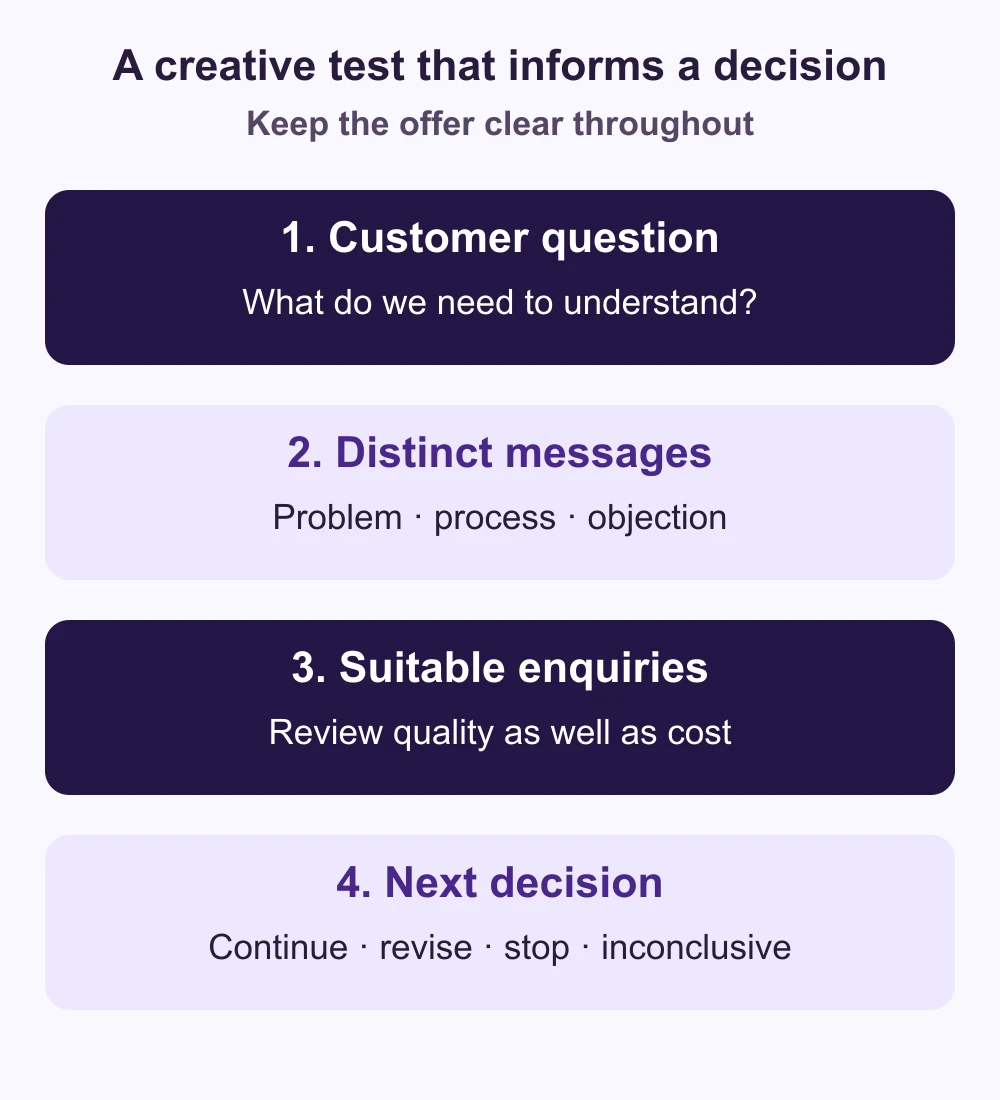
To test Meta ad creative for a service business, start with different reasons a customer might choose you. Keep the service and next step clear, decide what a suitable enquiry means, and record the question each ad is meant to answer. Changing a background colour is useful only when colour is the question you need to investigate.
A creative test should help you make a decision: which message deserves further investment, which needs better evidence, and which attracts the wrong requests. This guide gives owners and marketing teams a practical brief, three example angles and a way to review results without declaring a winner too early.
Choose one business question before making the ads
Write a sentence such as: “Does explaining our onboarding process attract more suitable enquiries than leading with the problem we solve?” That is more useful than “We need fresh creatives.” It connects production to a customer concern and a measurable outcome.
Define a suitable enquiry using criteria the sales team can actually check: the service requested, delivery location, business type and ability to proceed. Keep unresolved enquiries separate from rejected ones. A prospect who has not answered yet is not automatically unsuitable.
Choose the action you can support: a consultation request, quote form or relevant conversation. If that destination is still undecided, read our Meta instant forms versus landing pages guide. Changing the destination during a message test makes the comparison harder to interpret.
Develop distinct angles, not three near-identical slogans
An angle is the reason the message gives someone to consider your service. A hook is its opening line or visual. A format is how you present it, such as a static image or short video. Separating these helps explain what you changed.
The table below uses a hypothetical bookkeeping provider serving small service firms. These are starting ideas, not claims about a real GoSocial client or a promise that one angle will perform best.
| Angle | Opening idea | Evidence to prepare |
|---|---|---|
| Problem recognition | “Still sorting receipts at the end of every month?” Show the recurring task the service addresses. | An accurate explanation of which tasks are included and what the client still needs to provide. |
| Process clarity | “Here is what happens after your first enquiry.” Show the onboarding steps. | The real onboarding sequence, responsibilities and any conditions affecting timing. |
| Objection handling | “Already using accounting software? Here is where our support fits.” Explain the role of the service. | Verified supported tools, scope boundaries and an honest explanation of the handover. |
Use the same underlying offer and comparable call to action. Do not add a discount to one version, a different service to another and a new form to the third, then attribute the result to the headline. If you intentionally compare complete concepts, describe the result as a concept comparison rather than proof about one isolated element.
For each angle, ask what the viewer needs to believe and what evidence you can show. Use real demonstrations, approved customer material or a clear service explanation. Avoid invented testimonials, unverified response times and guaranteed financial outcomes. An attractive ad cannot make an unsupported promise true.
Turn each idea into a production brief
Give each concept an ID and write down the customer concern, opening, supporting evidence, offer, call to action and destination. Add the market, language, asset owner and approval date. The designer should know which statement must remain accurate, not just which colour to use.
Prepare assets for the placements you intend to use. Check text at actual phone size, captions where needed, legible contrast and whether important content is cropped. Review the whole journey: an ad promising a discussion should not arrive at a page that appears to sell an unrelated package.
Adapt international versions to the service you can deliver. A French-speaking prospect may need a French explanation and reply, not just a translated first sentence. Separate US, UK and France results where the offer, costs or buying journey differ; do not assume a message that works in one market has been validated everywhere.
Decide whether you need exploration or a controlled test
Exploratory delivery can help reveal questions worth investigating. It does not automatically establish that the creative caused a difference. Ads shown in different conditions, or with very different amounts of delivery, may not be directly comparable. Document those limitations.
If you need a more controlled answer, agree a test design with the person managing the account. Define the comparison, what stays stable, the main metric, review timing and stopping conditions before launch. Meta Blueprint’s guide to measurement studies distinguishes A/B tests, creative testing and lift studies. They answer different questions; a routine ad comparison is not automatically an incrementality study.
Match the number of variants to the budget and likely enquiry volume. You can prepare three angles and test fewer at once. There is no universal number of days, clicks or creatives that makes every service-business test reliable. Avoid promising a statistical conclusion from a small, uneven sample.
Review lead quality alongside the advertising numbers
Click-through rate and the cost of an enquiry can help explain the journey, but neither tells you whether the business can serve the person. Compare spend, enquiries, suitable enquiries and the eventual sales outcome, using consistent definitions and an appropriate follow-up window.
The figures below are entirely hypothetical, in euros. They illustrate the calculation; they are not a benchmark, forecast or test result.
| Measure | Concept A | Concept B |
|---|---|---|
| Spend | €360 | €360 |
| Enquiries | 24 | 12 |
| Suitable enquiries | 6 | 9 |
| Cost per enquiry | €15 | €30 |
| Cost per suitable enquiry | €60 | €40 |
Concept B has a lower observed cost per suitable enquiry in this example. That alone does not prove it will keep performing better. Check whether qualification is complete, whether the customers are comparable and whether enough evidence exists to support a decision. A sale may take longer than the first reporting window.
Meta Blueprint’s creative measurement course is a useful primary resource on tests and metrics. For your own review, distinguish observations, explanations to investigate and conclusions supported by the test design.
Finish with a decision you can use next week
Write a short record for each concept: what was tested, what happened, which limitations remain and what happens next. Choose among continuing the comparison, revising the message, improving the destination or stopping an unsuitable concept. “Inconclusive” is a valid result, not a reason to invent a winner.
When an angle looks promising, keep its underlying idea and investigate a focused refinement, such as its opening or demonstration. If all angles attract unsuitable requests, revisit the offer and qualification journey before ordering another batch of designs.
GoSocial can help connect creative production, campaign management and lead follow-up. Explore our Meta Ads service, including support for UK businesses and US businesses, or discuss your next creative test. Share your service, target markets, current ads and what makes an enquiry suitable.