
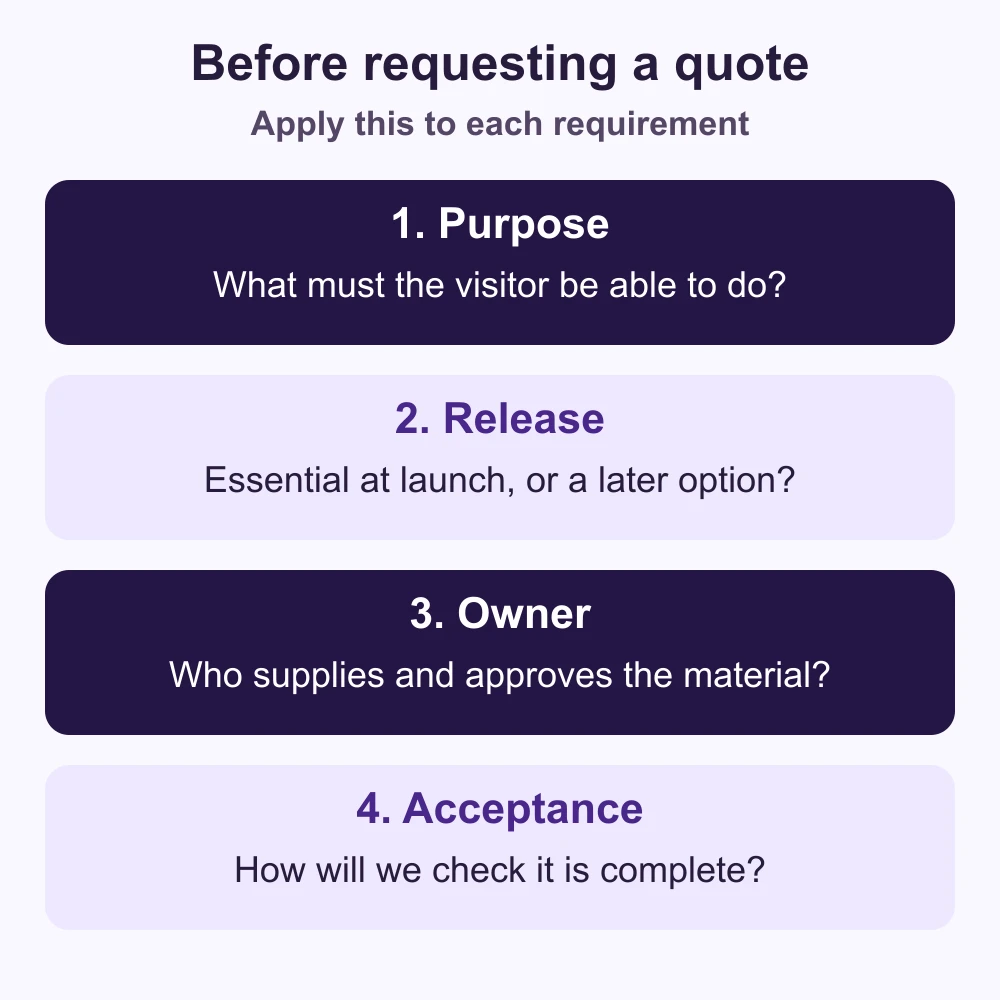
A useful website brief tells an agency what a visitor must be able to do, what belongs in the first release and who will supply the material. Before requesting a quote, make those decisions visible. You do not need to design every screen or choose every plugin.
For a service business, start with a specific enquiry journey: the right person understands the offer, checks whether you can help and sends enough information for a useful reply. This short guide includes a scope table and a brief you can copy into your own document.
Start with the customer and the next action
Name the main customer, their problem and the action you want. “Generate leads” leaves too much open. “Help operations managers request a discussion about ongoing IT support” gives the agency a clearer starting point. Explain which enquiries you cannot serve as well.
List the markets and working languages separately. Serving customers in the US, UK and France does not automatically mean three different websites. Specify where you can deliver, which languages need complete content and who will answer each type of enquiry. Distinguish a translated interface from translated service descriptions and follow-up messages.
If you are unsure whether the existing site needs rebuilding, use our redesign versus targeted improvements guide before defining the project.
Turn wishes into a scope an agency can price
This hypothetical example concerns a business IT-support provider. It illustrates how to write requirements; it is not a GoSocial client result or a recommended specification for every company.
| Request | First release | Owner and check |
|---|---|---|
| Service pages | Three distinct services in English and French; list the six page URLs. | Client approves service details; agency checks both language journeys. |
| Enquiry form | Service, business email and message; route to the agreed inbox. | Agency tests submission and receipt; client confirms who responds. |
| Customer evidence | Two approved examples with permission to publish. | Client supplies accurate material by the agreed content date. |
| Online booking | Optional later phase, priced separately. | Client confirms the booking workflow before commissioning it. |
Count pages, distinct layouts and languages explicitly. Six pages using one layout are a different task from six unique layouts. Name any booking platform, CRM or payment connection, and describe what information must pass between systems. Mark unknowns as questions rather than silently treating them as included.
Agree content, testing and the handover
For each page, assign responsibility for writing, translation, images and approval. State what already exists and what needs creating. Share access through an agreed secure process when needed; do not put passwords in the brief. Name one person who consolidates feedback and signs off the work.
Include accessibility from the start. W3C’s accessibility planning guidance supports clear responsibilities and early evaluation. Ask the agency to specify the target, testing and exclusions. A sample check is completing the enquiry journey by keyboard, with understandable field labels and errors; that alone is not a full accessibility assessment.
For a replacement site, list important existing pages and downloads. Where URLs change, ask who will map the old addresses to relevant destinations and test the redirects. Google’s site-move guidance explains that mapping and monitoring work. A new design does not by itself protect search visibility.
Agree who controls the domain, hosting and software accounts after launch. Request a breakdown of build work, recurring fees, maintenance, training and the period for correcting agreed defects. Ask how later additions will be quoted.
A brief you can copy and complete
- Business and audience: We help [customer] with [problem] in [markets and languages].
- Main action: The visitor should [action]; a suitable enquiry means [criteria].
- First release: [Pages, languages, forms and integrations]. Later options: [list].
- Content: [Person] supplies [material] by [date]; [person] approves it.
- Existing site: Preserve [important pages and assets]; investigate [known problems].
- Acceptance and handover: Demonstrate [checks]; hand over [accounts, instructions and training].
- Constraints: Budget range [amount and currency], target date [date and reason], decision-maker [name].
Send the same version to each agency. Compare what is included, excluded and still assumed before comparing totals. If a deadline is fixed, ask which scope can realistically be delivered by it. Keep unresolved decisions visible rather than requesting a precise price for an undefined build.
GoSocial can help turn an initial brief into a defined website scope. Explore our website design and development service or send us your project outline, including your markets, languages and intended launch.